Pallet Flow (Gravity) Racking System
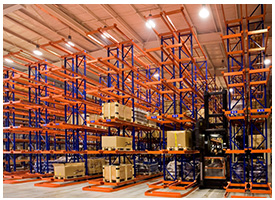
The Pallet Flow (Gravity) Racking System is a space-efficient storage solution used in Omani warehouses to manage high pallet volumes with automatic FIFO rotation. It relies on gravity-fed roller lanes to move pallets from loading points to retrieval positions. Pallet Flow Racking is commonly applied in logistics, food storage, and regional distribution facilities, supporting pallet loads typically between 800 kg and 2,200 kg across Oman’s industrial environments.
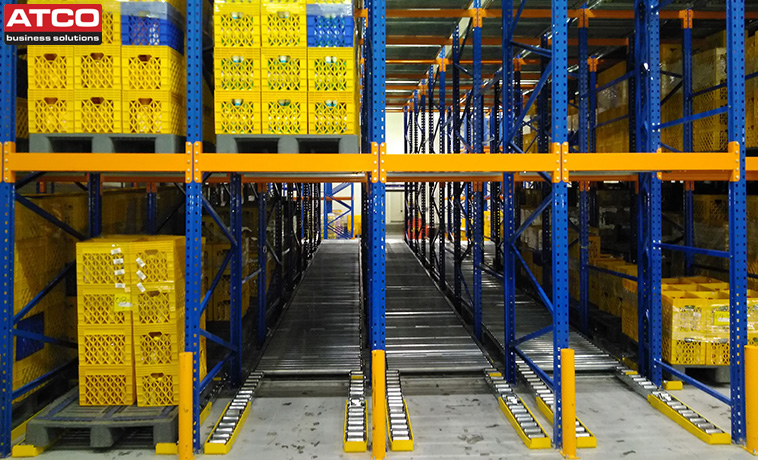
Pallets move along inclined roller tracks, with braking elements controlling speed and spacing. Rack heights are commonly designed between 6 m and 10 m, depending on building structure and forklift reach. Lane depth is selected based on inventory volume and dispatch frequency, allowing continuous pallet availability at the picking face. Pallet Flow Racking integrates well into Omani operations where throughput predictability, FIFO compliance, and efficient space utilization are essential for daily warehouse performance.
Key Features
- Gravity-fed roller lanes for automatic pallet movement
- FIFO operation for controlled stock rotation
- Compact storage with fewer aisles required
- Brake rollers to regulate pallet speed
- Lane depth matched to dispatch volume
- Suitable for temperature-controlled environments
- Clear separation of loading and picking zones
- Expandable system layout for future demand
Pallet Flow (Gravity) Racking System
Brochure | Quotation | Availability
Fill the form with valid details to receive the information.
Frequently Asked Questions
Omani warehouses use pallet flow racking where FIFO handling and compact storage are required. Facilities supporting Muscat and Sohar distribution routes rely on gravity lanes to maintain organized stock rotation while reducing aisle requirements in space-constrained buildings.
The system is well suited for fast-moving, uniform goods such as packaged food, beverages, and export cargo. Omani operations benefit when pallet turnover is predictable and consistent flow is required to meet regional dispatch schedules.
Forklifts load pallets at the rear and retrieve them at the front without entering the rack. In Oman, this reduces travel distance, limits operator fatigue, and improves handling consistency in warehouses with moderate labor availability.
Engineers assess floor level accuracy, roof height, and available slope length. In Oman, rack heights typically range between 6 and 10 meters, ensuring gravity flow remains stable while matching forklift reach and building constraints.
In regions such as Salalah, corrosion monitoring and regular roller inspection are important. Maintenance teams ensure rollers rotate freely and protective coatings remain intact, supporting reliable gravity movement under humid environmental conditions.
Customer Testimonials
GET A QUOTE
Tell us about your business requirement, one of our technical expert will be in touch with you soon..!
NEW PRODUCTS ALERTS