How PALOMAT Automates Empty Pallet Handling in Warehouses
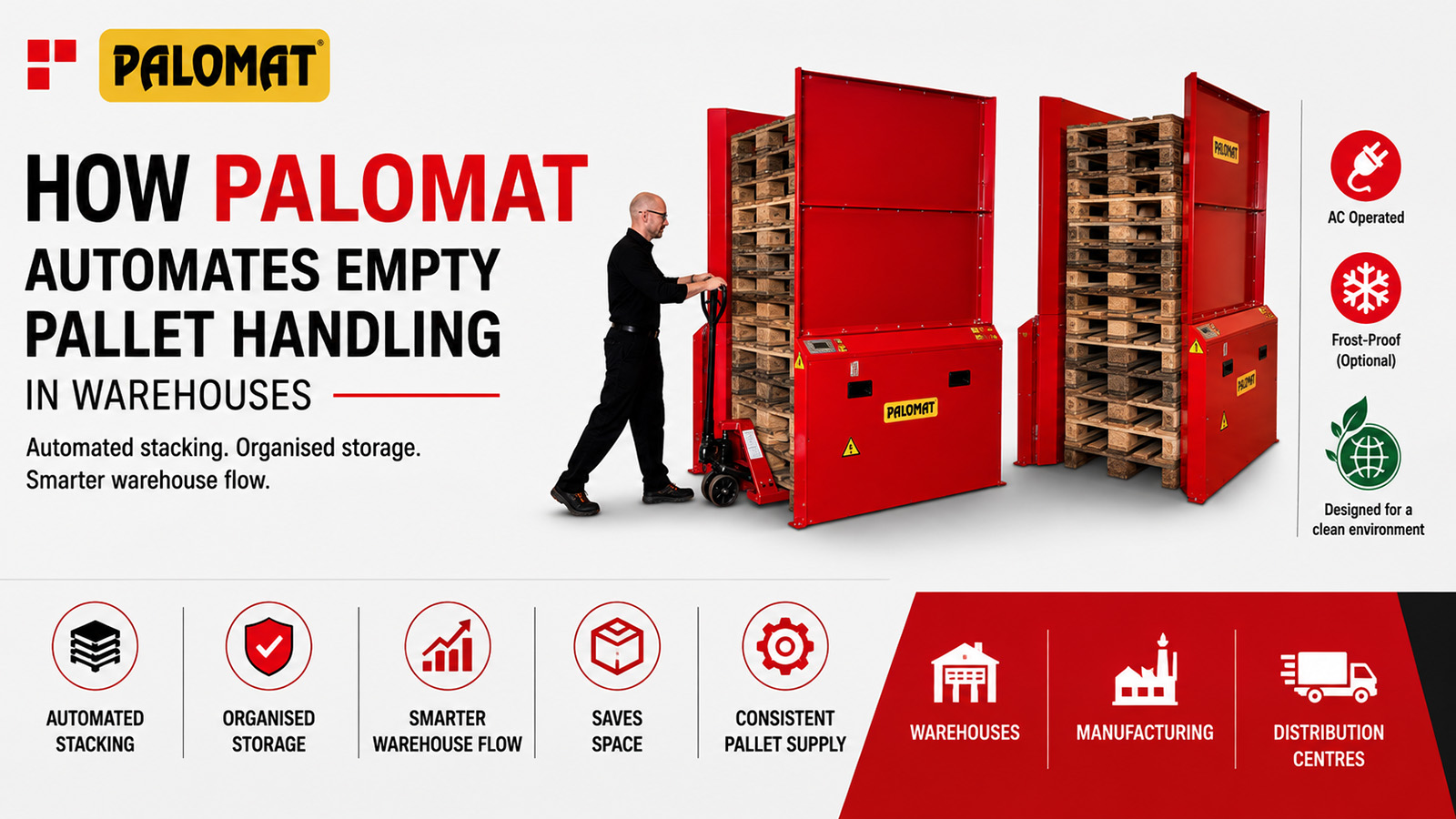
A busy distribution centre can move hundreds of pallets through receiving, picking, packing, production, and dispatch areas during a shift. Once the goods are removed, however, the empty pallets still have to go somewhere.
One pallet beside a workstation is rarely a problem. Ten or twenty can be. Empty pallets begin occupying staging space, narrowing movement areas, and forcing operators to stop their main work to move or stack them. Forklifts may also be used for short pallet-clearing tasks that add little value to the actual operation.
This is where automated empty pallet handling becomes useful. Instead of treating empty pallets as an occasional housekeeping issue, warehouses can manage them as part of the material flow. PALOMAT empty pallet organisers are designed to automate the stacking and dispensing of empty pallets, creating a controlled point for a repetitive warehouse task.
Why Empty Pallets Become an Operational Problem
Empty pallets often appear in several parts of a warehouse at the same time. Goods receiving generates them after products are transferred. Picking and replenishment areas create empty pallets as stock moves through the facility. Packing and production lines may consume and release pallets continuously.
Without a defined process, operators usually place empty pallets wherever temporary space is available. Eventually, somebody has to collect, stack, or relocate them.
An operator may leave a productive task to move a pallet. A pallet truck may be diverted to clear several empties. A forklift may travel across the warehouse simply to reorganise a stack. During a busy shift, these small interruptions can become part of the normal workflow without managers noticing how much time they consume.
There is also a safety consideration. Repeatedly lifting, positioning, or removing empty pallets manually can place unnecessary physical demand on employees. Poorly organised stacks can also create problems around pedestrian routes and material handling areas.
The issue is therefore not simply where to store empty pallets. It is how to manage them without continually interrupting people, equipment, and warehouse flow.
How PALOMAT Automates Empty Pallet Handling
A PALOMAT empty pallet organiser creates a dedicated location where empty pallets can be automatically stacked and dispensed.
Instead of an employee repeatedly building a pallet stack by hand, an empty pallet is placed at the pallet organiser. The system handles the stacking process and keeps the pallets together in a controlled vertical stack. When an empty pallet is required, an individual pallet can be dispensed for the next operation.
Empty pallet arrives PALOMAT receives it Pallet is stacked automatically Individual pallet is dispensed when required
This changes an irregular manual activity into a repeatable warehouse process.
For example, consider a packing area where finished orders regularly require empty pallets. Without an organised system, workers may keep several pallets beside the line so that one is always available. As those pallets are consumed and replaced, the area can gradually become congested.
An automated pallet organiser allows the operation to maintain a controlled pallet supply without creating several temporary stacks around the work area.
PALOMAT does not replace forklifts, pallet trucks, conveyors, or warehouse operators. It automates one specific task within the wider material handling process: managing empty pallet stacks.
Where the Productivity Improvement Actually Comes From
The main productivity benefit is not simply faster pallet stacking. It comes from removing unnecessary handling from the working day.
When employees no longer need to repeatedly organise empty pallets, they can remain focused on receiving, picking, packing, replenishment, production, or dispatch activities.
Forklift and pallet truck movements can also become more purposeful. If empty pallets are scattered across several locations, handling equipment may make additional trips just to collect and reorganise them. A defined pallet management point can make those movements more predictable.
Floor space is another consideration. Warehouse managers often focus on pallet positions inside the racking while overlooking space lost at ground level. Empty pallets temporarily stored beside workstations, columns, conveyors, or staging areas can gradually consume useful operating space.
Keeping empty pallets together in a vertical stack can help maintain cleaner working areas and reduce uncontrolled temporary storage.
This can be particularly relevant in busy distribution and industrial operations across the UAE, Saudi Arabia, Oman, and other GCC markets, where warehouse space, fast order turnaround, and labour efficiency can all influence operating cost.
The Hidden Cost of Manual Pallet Handling
One common mistake is evaluating empty pallet handling only by the cost of labour used to stack pallets.
The actual operational cost can be wider. Managers should also consider time spent walking between pallet locations, forklift or pallet truck movements used to relocate empty pallets, interruptions to productive work, floor space occupied by temporary stacks, and delays caused when pallets are not available where they are needed.
These activities may only take a few minutes individually. Repeated across multiple operators and shifts, they can become a recurring operating cost.
There is also an overlooked risk in using forklifts for every pallet-related task. A forklift may be capable of moving empty pallet stacks, but that does not automatically make it the most efficient use of the machine.
If a forklift is repeatedly diverted from replenishment, loading, or production support to manage empty pallets, the warehouse is using a higher-value asset for a relatively simple housekeeping activity.
Automation should be evaluated by asking which unnecessary movements it removes from the operation, not only how quickly the machine performs the task.
What to Check Before Selecting an Empty Pallet Organiser
Installing pallet automation without first studying the workflow can simply move the problem to another location.
A common selection mistake is concentrating on the pallet organiser itself while giving too little attention to where empty pallets are generated and where they are required next.
Placing the system far from the natural pallet flow may force employees or material handling equipment to travel additional distances. The machine works correctly, but the overall process becomes inefficient.
- How many empty pallets are handled during a normal and peak shift?
- Where are empty pallets generated, and where are they needed again?
- What pallet sizes, materials, and configurations are being handled?
- How are pallets currently stacked, transported, and retrieved?
- How much floor space is being used for temporary pallet storage?
- Will the system interact safely with pedestrians, forklifts, pallet trucks, conveyors, or production equipment?
- Is stacking, dispensing, or both required within the workflow?
Pallet compatibility is particularly important. Warehouses should not assume that every pallet type behaves identically simply because the outside dimensions appear similar. Pallet construction, condition, orientation, and handling requirements should be checked against the selected system.
Maintenance access also needs consideration. Like other automated warehouse equipment, a pallet organiser should be positioned so that routine inspection and maintenance can be carried out without creating unnecessary disruption to surrounding operations.
Safety Depends on the Complete Pallet Handling Process
Automating repetitive pallet stacking can reduce direct manual interaction with pallet stacks, but the equipment itself should not be treated as a complete safety solution.
Managers still need to consider how operators approach the system, where pedestrians move, how forklifts or pallet trucks deliver pallets, and whether the surrounding area remains clear during busy periods.
A practical operating procedure should define how damaged pallets are identified and removed from the normal pallet flow.
Operator training should also explain more than how to activate the equipment. Employees should understand which pallets can be handled, how pallets should be positioned, what to do when a pallet is damaged or incorrectly aligned, and when the system should be stopped for inspection.
When Does Empty Pallet Automation Make Operational Sense?
PALOMAT empty pallet organisers are most relevant where pallet handling is frequent enough to become a repetitive operational task rather than an occasional activity.
This can include distribution centres, manufacturing facilities, food and beverage operations, cold stores, packaging areas, retail logistics operations, and other facilities with regular pallet circulation.
The strongest case for automation usually appears when several problems occur together: employees repeatedly stack pallets, empty pallets occupy working space, forklifts make unnecessary collection movements, pallet availability interrupts production or packing, or housekeeping becomes difficult during peak periods.
Before making a decision, observe one complete busy shift.
Track where empty pallets appear, who moves them, how far they travel, which equipment is used, how often employees interrupt their primary work, and where pallets wait before being reused or removed.
That observation often provides more useful information than simply counting the number of pallets in the warehouse.
The final question is not whether an automated pallet organiser can stack empty pallets. It is whether removing manual pallet stacking and dispensing from the workflow will eliminate enough unnecessary movement, handling, congestion, and operator effort to improve the operation as a whole.
GET A QUOTE
Tell us about your business requirement, one of our technical expert will be in touch with you soon..!
NEW PRODUCTS ALERTS