Electric Stackers (Rider)
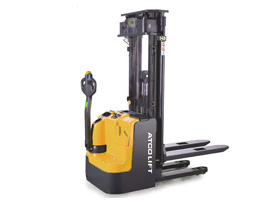
Electric Stackers (Rider) are electrically driven stacking machines used for pallet lifting and internal transport in controlled industrial environments. They are typically applied where higher movement frequency and stacking height are required without shifting to full-size forklifts. These machines generally support rated loads from 1200 kg to 2000 kg and accommodate vertical stacking up to 5.5 meters. Across Saudi Arabia, Electric Stackers are commonly selected for indoor logistics, manufacturing support zones, and warehouse operations requiring consistent load handling.

Warehouses and production sites in Riyadh and Dammam frequently rely on rider stackers for finished goods handling, raw material replenishment, and inter-department transfers. These units are designed around controlled lift speeds and stable mast behavior, allowing safe pallet placement within racking systems. Typical operating parameters include 1.2–2.0 ton load ratings and lift heights from 3500 mm upward, depending on mast selection and aisle constraints.
From a workflow perspective, Electric Stackers integrate efficiently into KSA logistics operations where electric-powered equipment is required for indoor compliance and predictable performance. Their maneuverability, combined with reduced turning radius, supports use in high-density storage layouts while maintaining consistent handling behavior across extended operating shifts.
Technical Specifications
| Product Code | ALPS1235N | ALPS1654N | ALPS2045N | ALMB1545ZTX | ALMB2055ZTX | ALMFA1545ZTX |
| Catalogue | Catalogue | Catalogue | ||||
| Power (battery, diesel, petrol, gas, manual) | Battery | |||||
| Operator type | Pedestrian/Stand-on | |||||
| Load Capacity / rated load Q(t) | 1.2 | 1.6 | 2.0 | 1.5 | 1.5 | 2 |
| Load centre distance C(mm) | 600 | |||||
| Load distance ,centre of drive axle to fork x(mm) | 647 | |||||
| Wheelbase y(mm) | 1167 | 1215 | 1327 | 1390 | 1390 | 1390 |
| Service weight (Kg) | 1080 | 1380 | 1620 | 1450 | 1450 | 1550 |
| Axle loading, laden front/rear (Kg) | 860/1420 | 1040/1940 | 1210/2410 | |||
| Axle loading, unladen front/rear (Kg) | 780/320 | 940/440 | 1090/540 | |||
| Tires | Polyurethane (PU) | |||||
| Tire size, front ΦxW (mm) | Φ230×70 | |||||
| Tire size, rear ΦxW (mm) | Φ85×75 | |||||
| Additional wheels(dimensions) ΦxW (mm) | Φ150x54 | |||||
| Wheels, number front/rear(x=driven wheels) | 1x+1/4 | |||||
| Track, front b10(mm) | 510 | |||||
| Track, rear b11(mm) | 390/505 | |||||
| Lowered mast height h1(mm) | 2308 | 2410 | 2228 | |||
| Free Lift height h2(mm) | 1760 | 1820 | 1520 | 1550 | 1550 | 1970 |
| Lift height h3(mm) | 3500 | 5400 | 4500 | 4500 | 4500 | 5500 |
| Extended mast height h4(mm) | 4088 | 5088 | 5208 | 5000 | 5500 | 6040 |
| Height of tiller in drive position min./ max. h14(mm) | 950/1350 | |||||
| Height, lowered h13(mm) | 90 | |||||
| Overall length l1(mm) | 1855 | 1896 | 2025 | |||
| Length to face of forks l2(mm) | 705 | 746 | 875 | |||
| Overall width b1(mm) | 790 | 850/1000 | ||||
| Fork dimensions s/e/l(mm) | 60/180/1150 | |||||
| Distance between fork-arms b5(mm) | 570/685 | |||||
| Machine Dimension (LxWxH) (mm) | 1855 * 790 * 2308 | 1896 * 790 * 2410 | 2025 * 790 * 2228 | |||
| Packing Dimension (LxWxH) (mm) | 1955 * 910 * 2558 | 1950 * 910 * 2600 | 2125 * 920 * 2308 | |||
| Net Weight (kg) | 1080 | 1380 | 1620 | |||
| Gross Weight (kg) | 1100 | 1400 | 1640 | |||
| Ground clearance, centre of wheelbase m2(mm) | 28 | 28 | 23 | 30 | 30 | 30 |
| Aisle width for pallets 1000X1200 crossways Ast(mm) | 2285 | 2385 | 2455 | 2490 | 2490 | 2490 |
| Aisle width for pallets 800X1200 lengthways Ast(mm) | 2250 | 2290 | 2420 | 2450 | 2450 | 2450 |
| Turning radius Wa(mm) | 1380 | 1420 | 1550 | 1655 | 1655 | 1655 |
| Travel speed, load/unloaded (km/h) | 7.0/8.0 | 7.0/8.0 | 6.0/7.0 | 5.0/6.0 | 5.0/6.0 | 5.0/6.0 |
| Lift speed, load/unloaded (m/s) | 0.09/0.14 | 0.13/0.20 | 0.13/0.20 | |||
| Lowering speed, load/unloaded (m/s) | 0.25/0.20 | 0.28/0.23 | 0.28/0.23 | |||
| Max. gradeability, load/unloaded (%) | 6/12 | 6/12 | 6/10 | |||
| Service brake | Electromagnetic | |||||
| Battery voltage, nominal capacity K5 (V/Ah) | 24/180 | 24/270 | 24/350 | 24/210 | 24/210 | 24/210 |
| Energy consumption acc: to VDI cycle (kWh/h) | 0.95 | 1.34 | 1.70 | |||
| Type of drive control | AC- speed control | |||||
| Sound level at driver`s ear acc. to EN 12053 dB(A) | <70> | |||||
Key Features
- Stand-on rider configuration supporting higher travel efficiency
- Electric drive system suitable for enclosed industrial spaces
- Multiple load capacity variants aligned with warehouse demand
- Lift mast options for medium and high stacking applications
- Controlled acceleration and braking for pallet stability
- Compact turning profile for narrow aisle movement
- Industrial-grade wheel assemblies for warehouse flooring
- Designed for repetitive duty cycles in logistics operations
Electric Stackers (Rider)
Brochure | Quotation | Availability
Fill the form with valid details to receive the information.
Product Videos

Frequently Asked Questions
In Saudi Arabia, rider electric stackers are widely used in large logistics hubs and manufacturing plants to move pallets across long internal routes. Facilities in Riyadh and Dammam often rely on them to bridge the gap between pedestrian equipment and forklifts for medium-duty operations.
The rider platform reduces operator fatigue during repetitive transport tasks. In Saudi production facilities, this allows faster replenishment of raw materials and smoother movement between production lines, staging areas, and finished goods storage without increasing floor congestion.
They are well suited for moderate to high-throughput applications where pallet flow is continuous but loads remain within rated limits. Saudi operators typically deploy them for structured workflows rather than irregular outdoor handling or uneven surfaces.
Clear aisle markings, speed control, and operator training are critical. In busy Saudi warehouses, separation between pedestrian traffic and rider-operated equipment is essential to reduce collision risk, especially during peak loading and dispatch periods.
Battery charging schedules and temperature management are key factors. In Saudi Arabia, maintenance teams often plan opportunity charging or battery rotation to support long operating shifts while maintaining consistent lift performance and avoiding downtime.



Customer Testimonials
GET A QUOTE
Tell us about your business requirement, one of our technical expert will be in touch with you soon..!
NEW PRODUCTS ALERTS