Standing Type VNA Side Stacker
The Standing Type VNA Side Stacker is a narrow aisle material handling truck used for pallet movement, storage, and retrieval in warehouses with limited aisle space. It is suitable for logistics facilities, industrial warehouses, production sites, and distribution centers that require higher storage density. The side-access fork arrangement allows handling tasks without frequent vehicle turning, helping improve rack utilization. Available with capacities up to 1.5 tons, the unit operates in stacking aisles from approximately 1800 mm with guide rails and around 2000 mm without guide rails, supporting warehouse operations throughout Saudi Arabia.
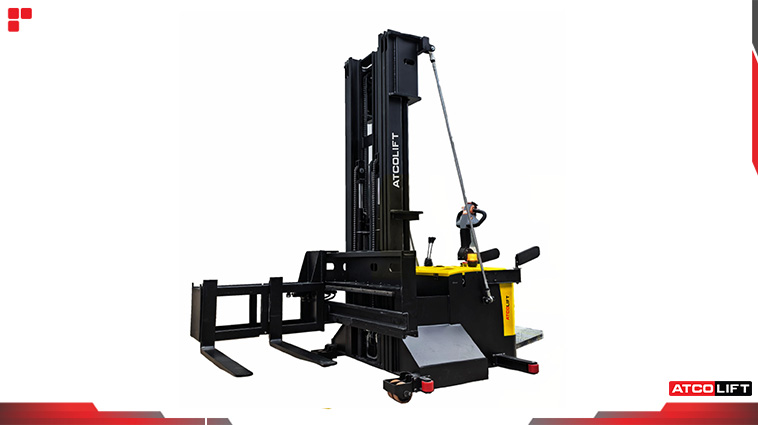
The Standing Type VNA Side Stacker is engineered for warehouses that utilize very narrow aisle storage systems. Its side-loading mechanism allows operators to place or retrieve pallets directly from racking locations while minimizing the maneuvering space typically required by conventional forklifts.
The equipment is frequently used in industrial storage facilities, manufacturing warehouses, spare parts distribution centers, and retail logistics operations in Riyadh and Jeddah where storage optimization is a key operational objective. By reducing aisle width requirements, warehouses can increase storage capacity without expanding floor space.
Typical models support handling capacities up to 1.5 tons and can work within stacking aisles from approximately 1800 mm when guide rails are used. Without guide rails, aisle requirements are typically around 2000 mm. The machine also supports main aisle widths of approximately 3.5 meters for movement between storage sections. The standing operator design assists with visibility during stock handling activities. The truck integrates with pallet racking systems, inventory management workflows, warehouse replenishment processes, and high-density storage applications commonly found across Saudi industrial sectors.
The equipment is frequently used in industrial storage facilities, manufacturing warehouses, spare parts distribution centers, and retail logistics operations in Riyadh and Jeddah where storage optimization is a key operational objective. By reducing aisle width requirements, warehouses can increase storage capacity without expanding floor space.
Typical models support handling capacities up to 1.5 tons and can work within stacking aisles from approximately 1800 mm when guide rails are used. Without guide rails, aisle requirements are typically around 2000 mm. The machine also supports main aisle widths of approximately 3.5 meters for movement between storage sections. The standing operator design assists with visibility during stock handling activities. The truck integrates with pallet racking systems, inventory management workflows, warehouse replenishment processes, and high-density storage applications commonly found across Saudi industrial sectors.
Technical Specifications
| Model | ALNSV1560TX |
| Power Type | Battery |
| Load Capacity | 1,500 kg |
| Load Center | 600 mm |
| Maximum Lift Height | 6,000 mm |
| Travel Speed (Loaded / Unloaded) | 4 / 5 km/h |
| Lift Speed (Loaded / Unloaded) | 100 / 110 mm/s |
| Minimum Stacking Aisle Width | ≥ 2,000 mm |
| Minimum Turning Channel Width | ≥ 3,500 mm |
| Fork Size | 35 × 100 × 1220 mm |
| Fork Side Shift Stroke | 1,250 mm |
| Fork Width Adjustment Range | 250 – 680 mm |
| Working Time | 5 – 8 Hours |
Standing Type VNA Side Stacker
Brochure | Quotation | Availability
Fill the form with valid details to receive the information.
Product Videos
Frequently Asked Questions
Large storage facilities often use VNA equipment to increase pallet capacity while maintaining accessibility to stored goods. By reducing aisle width requirements, warehouses can install additional racking positions within the same building, supporting efficient use of available storage space.
For consistent performance, warehouse floors should be level, stable, and capable of supporting both equipment and load requirements. Uneven surfaces may affect handling accuracy, especially when operating within very narrow aisles and high-density storage environments.
Capacity selection depends on pallet weight, load dimensions, lift height, rack configuration, and operational requirements. Warehouses should evaluate their heaviest routine loads rather than occasional handling requirements when selecting the appropriate equipment specification.
In many cases, yes. Existing rack layouts in Riyadh and Jeddah warehouses can often accommodate VNA equipment if aisle widths, rack clearances, pallet dimensions, and lifting requirements are suitable. A site assessment is recommended before implementation.
Routine inspections typically include forks, mast rollers, hydraulic systems, steering components, wheels, brakes, battery systems, and safety devices. Scheduled preventive maintenance helps reduce downtime and supports consistent warehouse productivity.
The standing position provides a direct view of travel paths, pallet locations, and rack structures. This visibility can assist operators when positioning loads within narrow aisles and carrying out storage or retrieval activities throughout the warehouse.
These trucks are frequently used in manufacturing plants, FMCG warehouses, industrial storage facilities, retail distribution centers, spare parts warehouses, and third-party logistics operations where high-density pallet storage systems are installed.

Customer Testimonials
GET A QUOTE
Tell us about your business requirement, one of our technical expert will be in touch with you soon..!
PROCEED
NEW PRODUCTS ALERTS